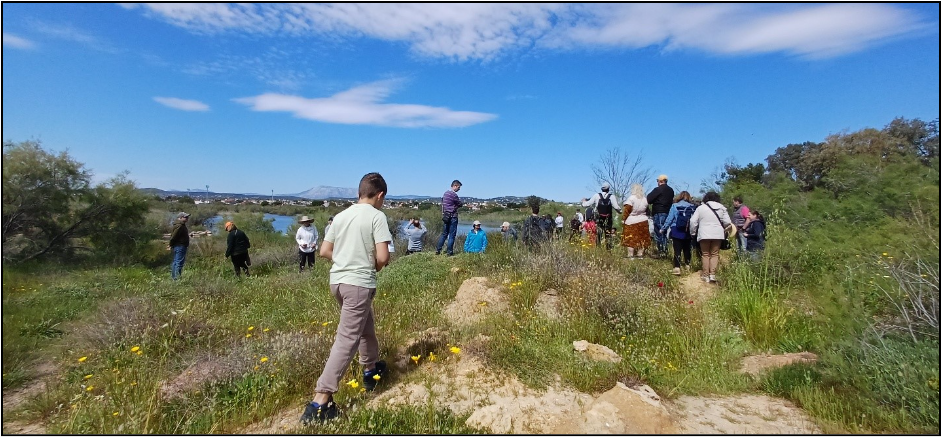
Written by Sofia Giakoumi
Introduction
The BlueLightS project promotes blue education as a pathway towards environmental awareness, active citizenship, and meaningful connections with aquatic environments. By encouraging interdisciplinary learning both inside and outside the classroom, BlueLightS aims to empower future generations to better understand rivers, wetlands, coasts and marine ecosystems, while developing the skills and motivation needed to contribute to their protection. Within this framework, the project supports educators through training opportunities, educational resources, and communities of practice that help transform environmental learning into hands-on experiences and real-world action. Inspired by the principles of open schooling and citizenship education, BlueLightS encourages schools to engage with local environmental challenges and connect learning with community participation and sustainability (BlueLightS, 2026).
In spring 2026, two online webinars for Greek secondary school educators explored how Project-Based Learning can support the implementation of the new national curriculum “Active Citizen Actions” through biodiversity-focused activities. The first webinar presented a complete educational project, centered on urban streams and biodiversity, providing ready-to-use educational materials that guide educators in designing field investigations for their students, documenting biodiversity and environmental pressures, producing educational resources, and participating in citizen science activities. Building on this foundation, the second webinar focused on the practical implementation of biodiversity monitoring through iNaturalist, introducing educators to observation protocols, species identification practices, data quality principles, and educational approaches for integrating citizen science into school activities (Giakoumi, 2026). Beyond teacher training, the webinars also introduced participants to the City Nature Challenge 2026 and invited them to explore opportunities for involvement through local biodiversity observation events across the Athens Metropolitan Area.
From Webinars to Real-World Participation
The response from the educational community was highly encouraging. More than 80 educators registered for the first webinar and nearly 60 for the second, demonstrating strong interest in biodiversity education, Project-Based Learning, and citizen science approaches.
Beyond participation in the webinars themselves, the initiative generated tangible engagement. Educators, citizen groups, environmental organisations and community members were invited to contribute to the organisation of the City Nature Challenge 2026 in the Athens Metropolitan Area through an open call promoted via the HCMR website, social media channels, and the webinar network (HCMR, 2026a). Ten individuals and organisations expressed interest in becoming local partners, and six of them ultimately collaborated in the implementation of biodiversity observation activities during the Challenge.
This progression from professional development to real-world participation illustrates an important outcome of the BlueLightS approach. Rather than remaining a theoretical training exercise, the webinars acted as a catalyst for community engagement, enabling educators and local stakeholders to move from learning about biodiversity and citizen science to actively contributing to biodiversity monitoring in their own communities.
City Nature Challenge 2026 in Athens Metropolitan Area
The City Nature Challenge (CNC) is a global citizen science initiative that encourages people around the world to observe and document biodiversity in their local communities using the iNaturalist platform (City Nature Challenge, 2026). Originally launched in 2016 as a friendly competition between Los Angeles and San Francisco, the initiative has grown into an international event involving hundreds of cities and metropolitan areas worldwide, generating millions of biodiversity observations while connecting people with nature and science.
In 2026, the Hellenic Centre for Marine Research (HCMR) coordinated for the first time the participation of the Athens Metropolitan Area in the City Nature Challenge. Building on previous local efforts and in parallel with the participation of Thessaloniki, coordinated by the environmental organisation iSea, the initiative invited citizens, schools, educators, community groups and environmental organisations across Attica to explore, observe and record local biodiversity.
The Challenge took place from 24 to 27 April 2026 and combined biodiversity monitoring with environmental education, outdoor learning and community engagement. Through organised BioBlitz events (HCMR, 2026b) and individual observations, participants contributed valuable biodiversity records while discovering the natural richness of urban and peri-urban environments throughout the Athens Metropolitan Area (City Nature Challenge 2026: Athens Metropolitan Area Project Page).
BioBlitzes across Attica
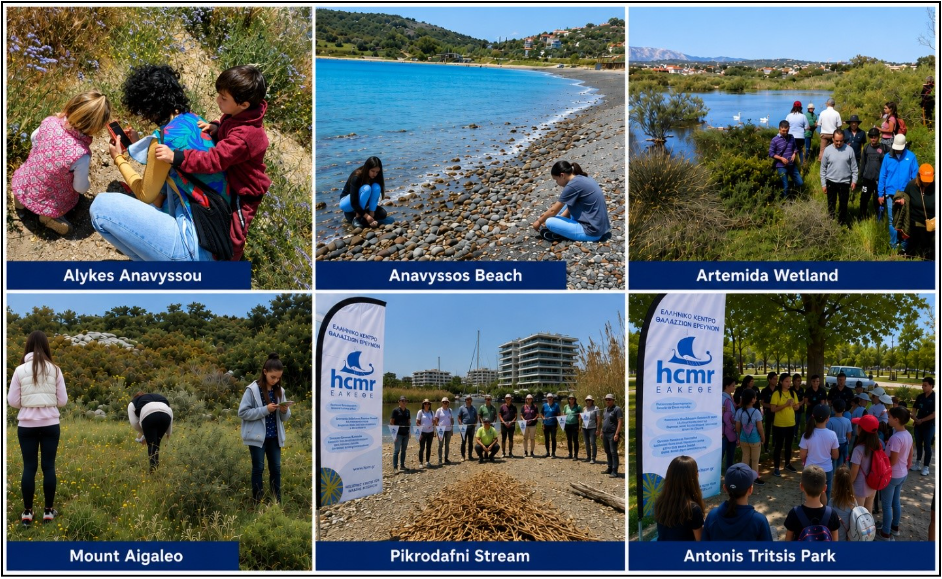
A series of BioBlitz events were organised across the Athens Metropolitan Area, bringing together educators, students, citizen groups, environmental organisations and individual nature enthusiasts. The activities covered a wide variety of habitats, including coastal areas, wetlands, streams, urban parks and school grounds, highlighting the remarkable biodiversity that persists within and around one of Europe’s largest metropolitan regions.
The programme began with activities at Anavyssos Beach and the Alykes Anavyssos Wetland, where students and teachers from schools in Anavyssos and Lagonisi as well as local community members explored coastal and wetland biodiversity. The following day, participants gathered at the Artemida Wetland in collaboration with members of the Initiative for the Protection and Restoration of the Great Rafina Stream, while another student-led activity took place on Mount Aigaleo through the environmental programme of the 4th Junior High School of Ano Liosia.
On Sunday, biodiversity observations continued at the Pikrodafni Stream estuary in cooperation with the Citizens’ Network for the Protection of Pikrodafni Stream and later at Kiteza Beach with the participation of FOTOESSA – Centre for Education, Research and Action and local citizens. The final day included activities at both the grounds of Moraitis School and Antonis Tritsis Metropolitan Park, organised in collaboration with the Environmental Education Centre (KEPEA) of Antonis Tritsis Park. While the Moraitis School Nature Observation and Interpretation Club carried out a biodiversity observation activity within the school grounds, the BioBlitz at Antonis Tritsis Metropolitan Park brought together a large group of students from Ralleios School of Piraeus, educators, and members of the wider community.
The BioBlitz at Antonis Tritsis Metropolitan Park provided a particularly inspiring example of how environmental education can connect diverse communities through citizen science. Alongside students from Ralleios School of Piraeus, educator Dimitris Tsakos brought members of the Environmental Science Group of the Onassis Public Senior High School of Acharnes to participate in biodiversity observations and species identification activities. The event also attracted international interest, as Alison Wood, a Fulbright Research Fellow and science educator currently conducting research in Greece, joined participants in documenting biodiversity and learning about the role of citizen science in environmental education. Students from different educational and cultural backgrounds worked together, demonstrating how citizen science can foster inclusion, curiosity and engagement with nature while generating valuable biodiversity data.
Results
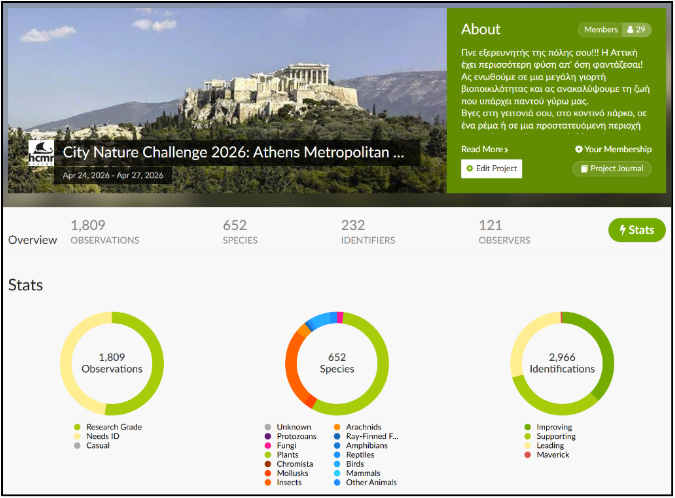
The City Nature Challenge 2026 generated a remarkable volume of biodiversity data across the Athens Metropolitan Area. By the end of the observation and identification period, participants had contributed more than 1,800 observations representing over 650 species, with the involvement of more than 100 observers and a large number of community identifications through iNaturalist (City Nature Challenge 2026: Athens Metropolitan Area Statistics).
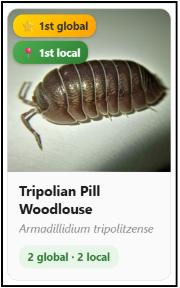
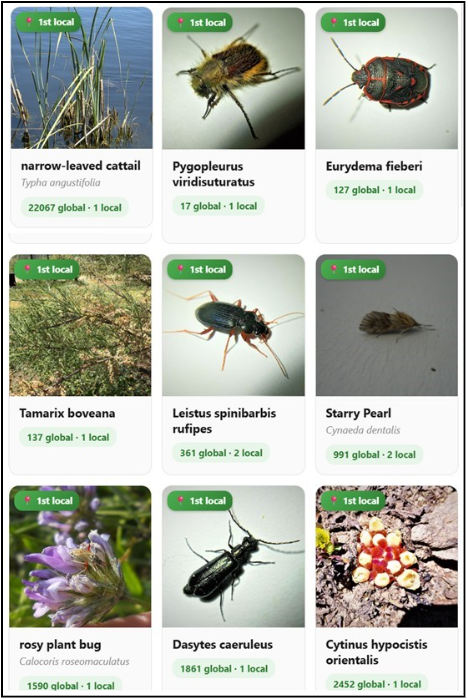
These observations originated from a wide variety of urban and peri-urban habitats, including islands, wetlands, streams, coastal areas, urban parks and school grounds. Beyond documenting common species, participants also recorded several observations of particular ecological interest, including multiple first observations for the Athens Metropolitan Area and at least one observation recognized as a first global record within the platform’s biodiversity database (City Nature Challenge 2026: Athens Metropolitan Area Statistics). Such findings highlight the potential of citizen science initiatives to contribute meaningful biodiversity information while engaging non-specialists in ecological observation and monitoring.
The local contribution formed part of a much larger international effort. Globally, the 2026 City Nature Challenge involved more than 106,000 observers who collectively contributed over 3 million observations representing more than 76,000 species worldwide (City Nature Challenge Global Results, 2026).
While the numerical results are important, the educational and social dimensions of the initiative were equally significant. Students, educators and citizens did not simply record biodiversity; they participated in a collaborative process of observation, identification and scientific contribution, experiencing firsthand how local environmental engagement can generate data with broader scientific value.
Reflections from the field
Additional perspectives on the biodiversity recorded during the Challenge were shared by freshwater ecologist Dr. Stamatis Zogaris, who participated in the BioBlitz at Artemida Wetland and later published a blog post presenting observations, photographs and ecological reflections from the event. His account highlighted both the biodiversity value of urban and peri-urban wetlands in Attica and the contribution that citizen science initiatives can make to documenting species occurrences and increasing public awareness of local ecosystems (Zogaris, 2026).
An international perspective
The educational value of the City Nature Challenge extended beyond the local community and attracted international interest. During the BioBlitz held at Antonis Tritsis Metropolitan Park, participants were joined by Alison Wood, a Fulbright Research Fellow from the United States and an experienced science and agriculture educator currently conducting research in Greece on outdoor learning and environmental education practices.
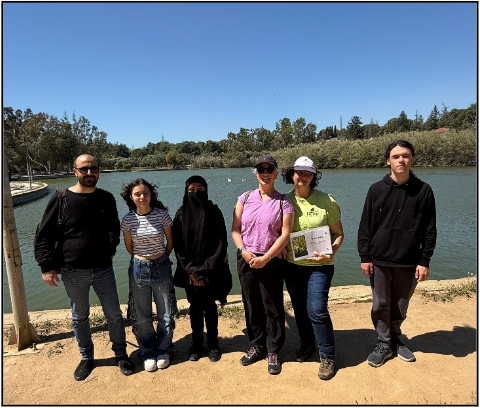
Wood participated in biodiversity observations alongside students, educators and citizen scientists, including members of the Environmental Science Group of the Onassis Public Senior High School of Acharnes, led by educator Dimitris Tsakos, and students from Ralleios School of Piraeus. Her experience at the event was later described in a personal blog article, where she reflected on the enthusiasm of the participants, the educational potential of citizen science, and the opportunities that biodiversity observation activities provide for connecting young people with nature (Wood, 2026).
Particularly noteworthy was her observation of students from diverse educational and cultural backgrounds working together to document local biodiversity. Through a shared process of exploration, observation and species identification, participants demonstrated how citizen science can create inclusive learning environments while simultaneously contributing valuable biodiversity data.
Wood’s reflections provide an external perspective on the broader significance of initiatives such as the City Nature Challenge. Beyond the biodiversity records generated, these activities foster environmental awareness, strengthen connections between schools and local communities, and offer authentic opportunities for learners to participate in scientific practices outside the classroom.
Why this matters for BlueLightS
The City Nature Challenge 2026 in the Athens Metropolitan Area demonstrated how the core principles of BlueLightS can be translated into meaningful action. Through a combination of teacher training, outdoor learning, citizen science and community engagement, participants moved beyond learning about biodiversity to actively documenting and exploring it in their local environment.
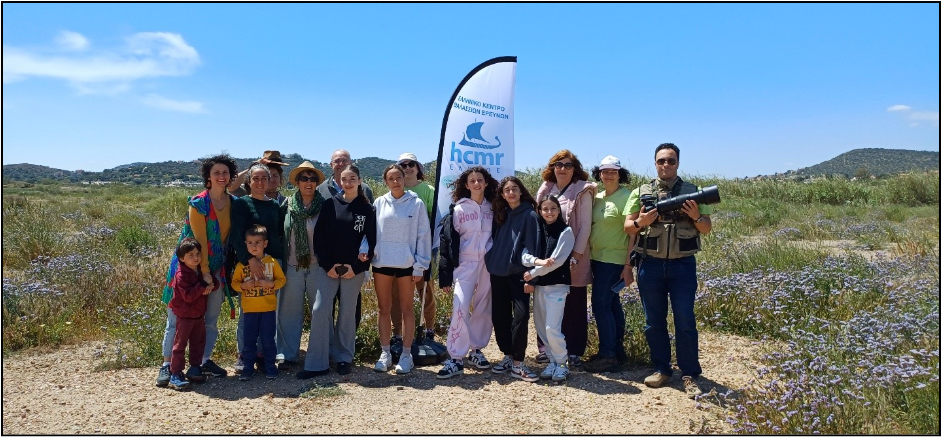
The initiative provided educators with an opportunity to apply concepts presented during the BlueLightS webinars in authentic settings, connecting classroom learning with real-world environmental challenges. Students engaged in observation, inquiry and data collection, while citizens, schools, environmental organisations and local communities collaborated in a shared effort to better understand the biodiversity of Attica.
Importantly, the activities highlighted the educational value of local ecosystems—including streams, wetlands, coastal habitats and urban green spaces—as living laboratories for environmental learning. By encouraging participants to observe, record and interpret biodiversity through iNaturalist, the Challenge fostered scientific literacy, environmental awareness and active citizenship while contributing valuable biodiversity data.
The experience also demonstrated how citizen science can act as a bridge between research and society. Participants were not simply recipients of scientific knowledge; they became contributors to a global biodiversity database, generating information that can support future research, education and conservation efforts.
Ultimately, the City Nature Challenge offered a practical example of how BlueLightS can inspire educators and communities to connect learning with action. By bringing together schools, scientists, citizens and local organisations around a common environmental goal, the initiative showed how participation, collaboration and curiosity can become powerful drivers of environmental stewardship and sustainable engagement with nature.
References / Further Reading
BlueLightS Project (2026). EnLIGHTening future Schools to deliver BLUE Sustainability in Europe. Available at: https://blue-lights.eu
BlueLightS Greek Blue Schools (2026). Webinar for Educators: From Field Activities to Citizen Science – Biodiversity Monitoring with iNaturalist. Available at: https://blue-lights.eu/%F0%9F%8E%93-webinar-%CE%B3%CE%B9%CE%B1-%CE%B5%CE%BA%CF%80%CE%B1%CE%B9%CE%B4%CE%B5%CF%85%CF%84%CE%B9%CE%BA%CE%BF%CF%8D%CF%82-02-%CE%B1%CF%80%CF%81%CE%B9%CE%BB%CE%AF%CE%BF%CF%85-2026-%CF%81%CE%AD/
City Nature Challenge (2026). Global Initiative. Available at: https://www.citynaturechallenge.org
City Nature Challenge 2026: Athens Metropolitan Area. Project Page. Available at: https://www.inaturalist.org/projects/city-nature-challenge-2026-athens-metropolitan-area
City Nature Challenge 2026: Athens Metropolitan Area. Project Journal. Available at: https://www.inaturalist.org/projects/city-nature-challenge-2026-athens-metropolitan-area/journal
City Nature Challenge 2026: Athens Metropolitan Area Statistics. Available at: https://citynaturestats.com/project/?project=city-nature-challenge-2026-athens-metropolitan-area
Giakoumi, S. (2026). From Field Activities to Citizen Science: Biodiversity Monitoring with iNaturalist. City Nature Challenge 2026: Athens Metropolitan Area Journal.
Hellenic Centre for Marine Research (HCMR) (2026). We Are Looking for Partners for City Nature Challenge 2026. Available at: https://www.hcmr.gr/el/news/anazitoume-synergates-gia-to-city-nature-challenge-2026/
Hellenic Centre for Marine Research (HCMR) (2026). City Nature Challenge 2026: Activities in Athens & Attica. Available at: https://www.hcmr.gr/el/news/city-nature-challenge-2026-draseis-se-athina-attiki/
iNaturalist. Biodiversity Observation Platform. Available at: https://www.inaturalist.org
Wood, A. (2026). City Nature Challenge 2026. Available at: https://alisonwood218.substack.com/p/city-nature-challenge-2026
Zogaris, S. (2026). Athens Metropolitan Area City Nature Challenge 2026. Available at: https://zogaris.blogspot.com/2026/05/athens-metropolitan-area-city-nature.html
Want to learn more about our project and register?
Register or log in to the Blue Education Platform!