Written by Elena Gallardo Cortes
Along the shores of Cádiz and Huelva, in southern Spain (Andalusia), lives one of Europe’s most endangered marine animals: the giant guitarfish (Glaucostegus cemiculus). In fact, this area is home to the last known population of the species in Europe. Despite laws that forbid catching or landing it, the giant guitarfish is still at serious risk of disappearing forever.
Why is the giant guitarfish in danger?
The main threat is fishing, both intentional catches and accidental ones. Even when fishermen do not mean to catch them, guitarfish can end up trapped in nets or on hooks (this is known as bycatch). Over time, these losses have drastically reduced their numbers.
Some people believe the species is doing fine because small, young guitarfish are occasionally caught. Unfortunately, this gives a false sense of security. Juveniles are easier to catch by accident, while adult guitarfish are now extremely rare. Without adults, the species cannot reproduce enough to survive in the long term.
Understanding their lives to protect them better
To save the giant guitarfish, scientists first need to understand how it lives:
• Where does it move?
• How long does it live?
• How and where does it reproduce?
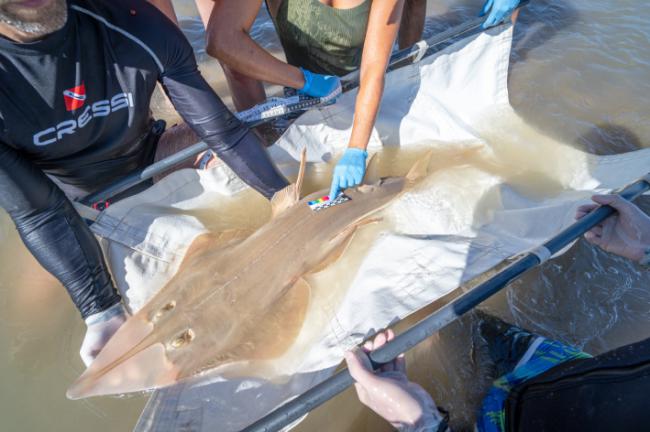
One of the simplest tools they use is spaghetti tags, small plastic labels attached harmlessly to the fish. These work a bit like a GPS for animals. If a tagged guitarfish is later caught by a fisherman, the tag number is reported, helping researchers learn how far the fish traveled and how long it survived.
Scientists also take a tiny sample of skin or muscle, without harming the animal, to study its DNA. This is like a family test. It helps answer an important question: Are the guitarfish from Cádiz and Huelva connected to other groups in the Atlantic or the Mediterranean?
If they are part of a larger “family,” conservation efforts need to protect all these areas together, not just one coastline.
Fishermen and citizens as key allies
Protecting the giant guitarfish is not only a scientific task, it is a shared effort.
Researchers work closely with fishermen, teaching them how to safely release guitarfish if they are caught by accident. A careful release can make the difference between life and death for a critically endangered animal.
They also ask for help from the general public. If anyone sees a giant guitarfish, all they need to do is send a photo by WhatsApp or email. Think of it as citizen detective work: each sighting helps map where these rare fish still survive.
Want to learn more about our project and register?
Register or log in to the Blue Education Platform!